
Featured Alum-a-Lift
Aerospace Ballscrew and Turbine Shaft Handler
Project
36425
Featuring
Powered Clamp w/Clamp-Force Limiter, Powered 360° Rotation
Handling
120 LB [54 KG] Aerospace Components
Details
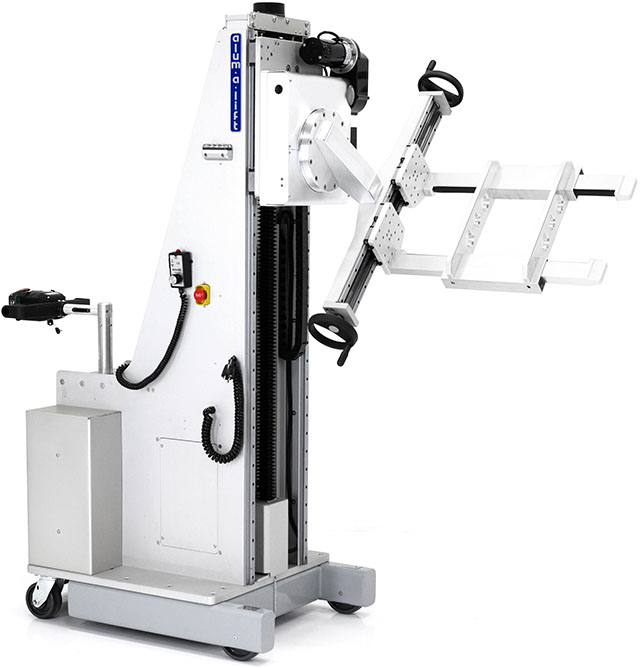
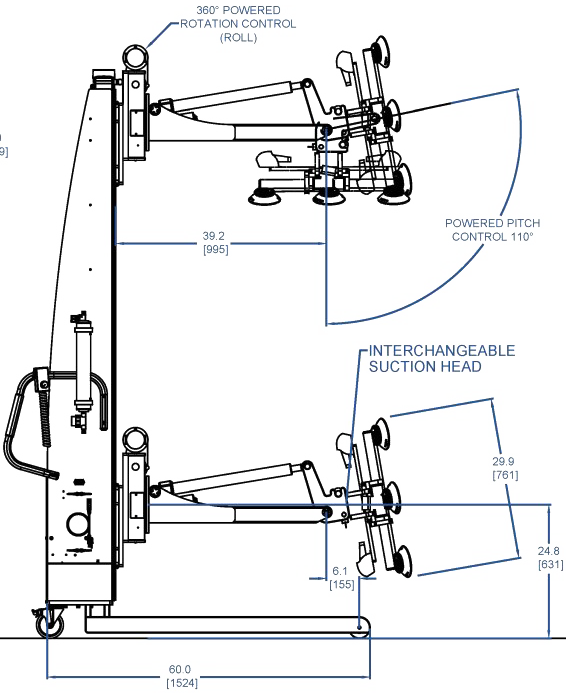
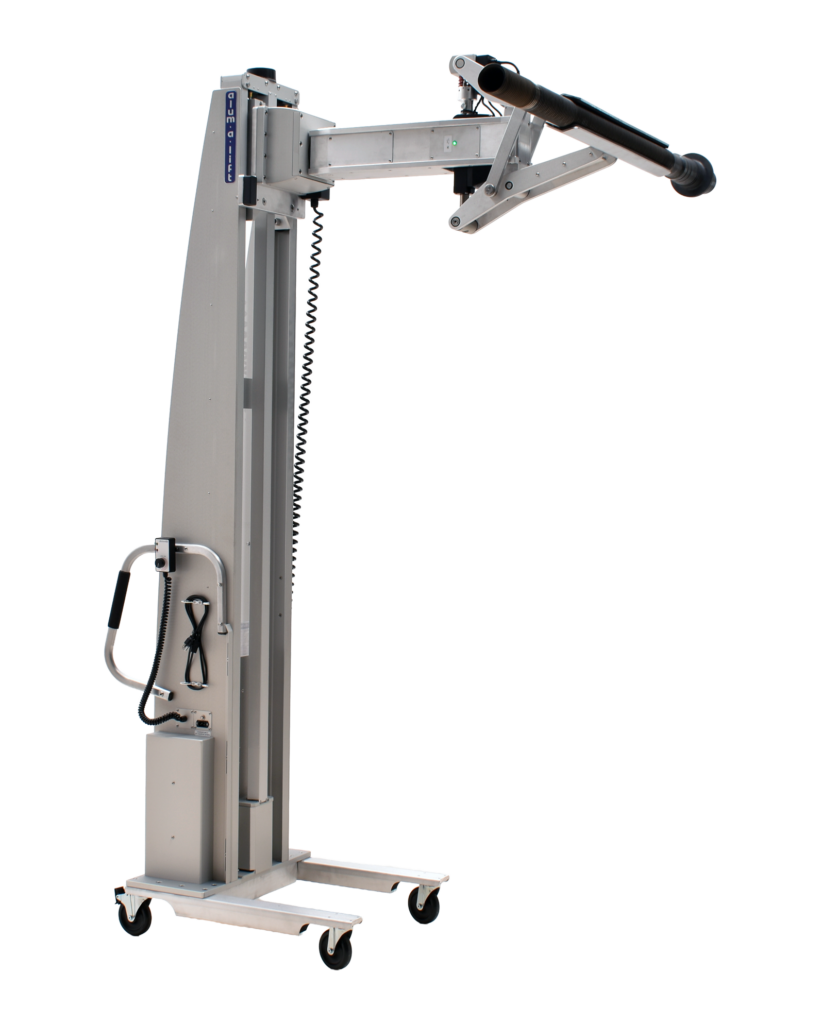
This custom lift is suitable for long aerospace components such as ballscrews, actuator shafts, landing gear, turbine shafts, and test/fixture bars, especially in cells and oven areas with no overhead crane access and limited floor clearance. These parts are difficult and hazardous to move by hand, particularly when they must be aligned precisely with machine tools, test stands, or assembly fixtures. The lift has self-locking rotation and includes stops at 90-degree increments, so a single operator can pick a component from a cart or workstation, index it to the required orientation, and present it accurately to the next step. The 102” cantilevered reach lets the lift reach forward beyond its own footprint and around existing equipment while keeping the operator in a stable, ergonomic position.
A powered gripper end‑effector secures the component along its length, supporting the load while protecting critical surfaces, sealing diameters, and bearing journals. Powered clamping with an integrated force limiter maintains consistent grip force without over‑tightening, reducing the risk of damage to high‑value parts. Once clamped, the operator uses the rotation module to fine‑tune position at the push of a button, simplifying insertion into chucks, rests, housings, or support bearings.
The battery‑powered, self‑contained chassis moves freely between workstations without relying on overhead cranes or fork trucks. Compact dimensions and intuitive controls make it well suited for narrow aisles, tight oven areas, and crowded cells, where precise positioning is more important than long‑distance transport. The result is a repeatable, one‑person handling method for aerospace ballscrews, turbine shaft, actuator shafts, landing‑gear components, and APU assemblies that improves safety and reduces operator strain while protecting high‑value components.
