
Featured Alum-a-Lift
Lightweight Textile Roll Handling Lift for Tight Storage
Project
34766
Featuring
Toolless Interchange, Interchangeable Prongs
Handling
Up to 300 LB [136 KG] Rolls
Details
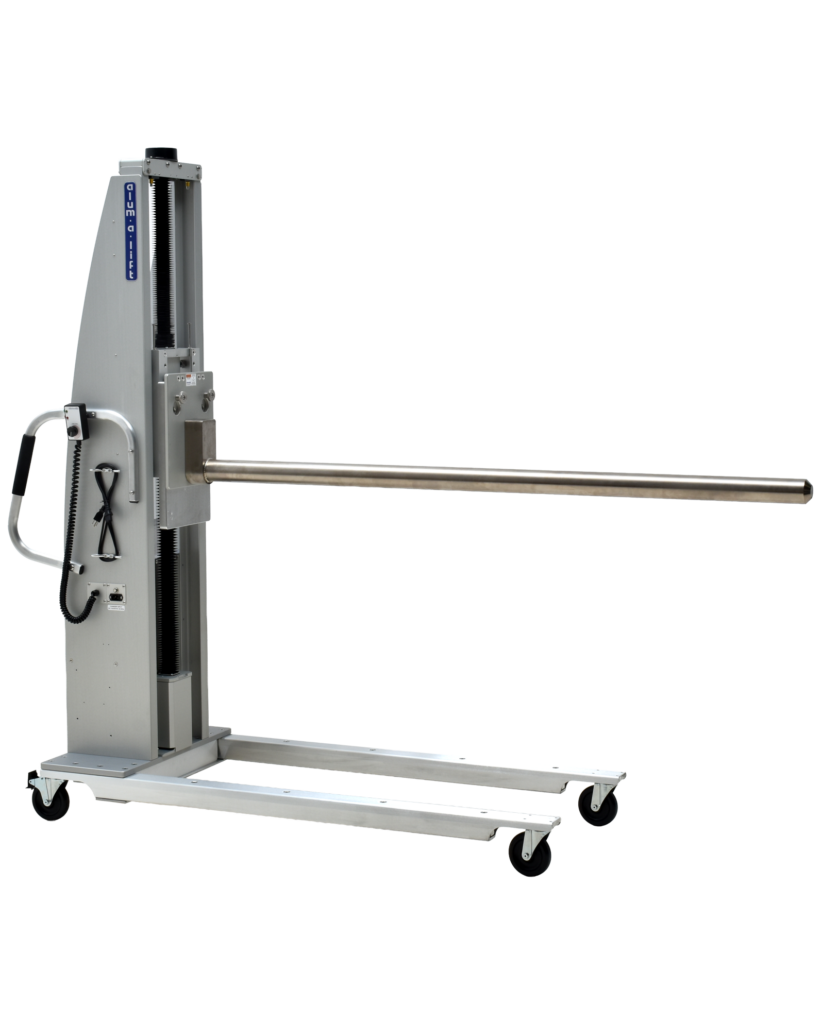
Fabric and textile roll handling in defense manufacturing often involve frequent changeovers between large and small rolls, tight storage cubbies, and sensitive flooring that can’t tolerate heavy point loads. This custom Alum-a-Lift fabric and textile roll handling lift uses a fork set end-effector that allows operators to easily load and unload different roll sizes interchangeably, eliminating manual roll changes and improving ergonomics. Rolls are picked from cubbies and placed onto worktables directly from a custom built Alum-a-Dolly rollout cart, creating a streamlined, ergonomic material handling workflow from storage to the cutting or processing area.
Because the roll handling lift must travel over partial wood/plywood flooring, distributed weight and maximum load were critical design criteria. The lightweight chassis is engineered for low point loading, minimizing floor damage from casters even under a full 300 lb. (136 kg) roll.
Interchangeable prongs are used to achieve the required capacity while maintaining compatibility with various roll and core sizes, making this an adaptable textile roll handling solution. To avoid the need for additional counterweight, the lift’s legs and wheels extend forward on either side of the lifting prong for inherent stability, and clearance beneath the rolls was carefully configured to eliminate manual sliding of rolls onto the prongs, reducing operator effort and making roll changeovers safer, and more efficient.
Beyond defense textiles, this lightweight, low point loading roll handling lift is wellsuited for packaging film, label stock, nonwovens, flooring, and other roll based materials where sensitive floors, tight storage, and frequent roll changeovers are challenges. It offers a versatile material handling solution for manufacturers who need to protect floors, reduce manual handling, and improve roll feeding efficiency.
